
The full power of high performance computing systems can best be exploited by people with specialized knowledge. At the same time, computational skills and knowledge are becoming a necessity for all fields of study. Therefore, the education and training in computational literacy, research computing and data science, is absolutely critical. SciNet has developed an education and training program (and an education site) for the wider scientific community aimed at helping students and users obtain the skills and knowledge required to get the most out of advanced research computing resources. It is one of our most important activities, and it has shown tremendous growth throughout SciNet’s existence, in particular in the area of data science.
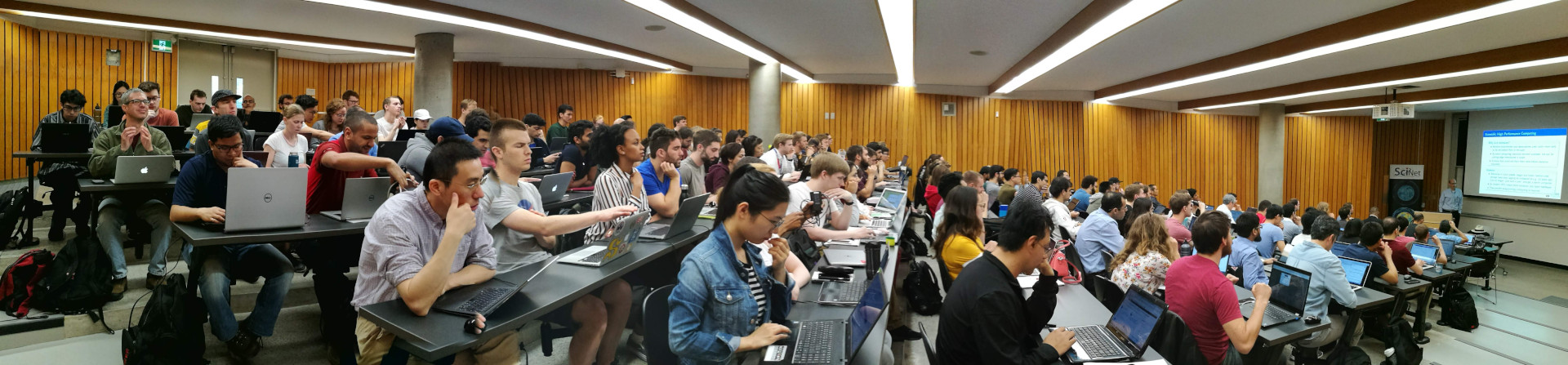
Together with our partner consortia in Ontario, SHARCNET and CAC, SciNet is involved in the annual Compute Ontario Summer Schools. These schools provide attendees with opportunities to learn and share knowledge and experience in high performance and technical computing. Before the Covid-19 pandemic, each of the three consortia organized one week of in-person summer school. In the last two instances, the number of unique attendees to the Toronto-based summer school was over 150. During the pandemic, these summer schools have been replaced with a variety of virtual events.
SciNet is also an organizer and sponsor of the International High Performance Computing Summer School (IHPCSS). This event is a graduate-level summer institute organized as a collaboration between SciNet, XSEDE, PRACE and RCCS/RIKEN. In 2015, we were the local organizers of the IHPCSS, when it was held at the University of Toronto. The IHPCSS is an expenses-paid program which is open to graduate students from Canada, the US, Europe and Japan, and other participating regions. The demand from Canadian students is consistently about ten times larger than the number of available spots, further evidence for the demand for training in research computing.
Graduate courses
By partnering with other departments in the University, an increasing number of SciNet’s training courses have been converted into graduate courses at the University of Toronto. Our current partners include UofT’s Departments of Physics, Astrophysics, Chemistry, and Ecology and Evolutionary Biology and the Institute for Medical Sciences, but the courses also draw students from other faculties such as Engineering.
SciNet Certificate Program
SciNet has been teaching courses on scientific technical computing and high performance computing for the Toronto-area research community since 2009. Since 2013, it offers recognition to attendees in the form of SciNet Certificates. There are currently three certificate offerings: a Certificate in Scientific Computing, a Certificate in High Performance Computing, and a Certificate in Data Science.
Seminars and colloquia
SciNet team members regularly give talks as part of the Compute Ontario colloquium series, a weekly Zoom meeting on Advanced Research Computing, High Performance Computing, Research Data Management, and Research Software topics. Previously, we organized in-person monthly talks known as SciNet User Group Meetings (SNUGs). Many of the talks in these series are available on our YouTube channel  .
.
Teach cluster
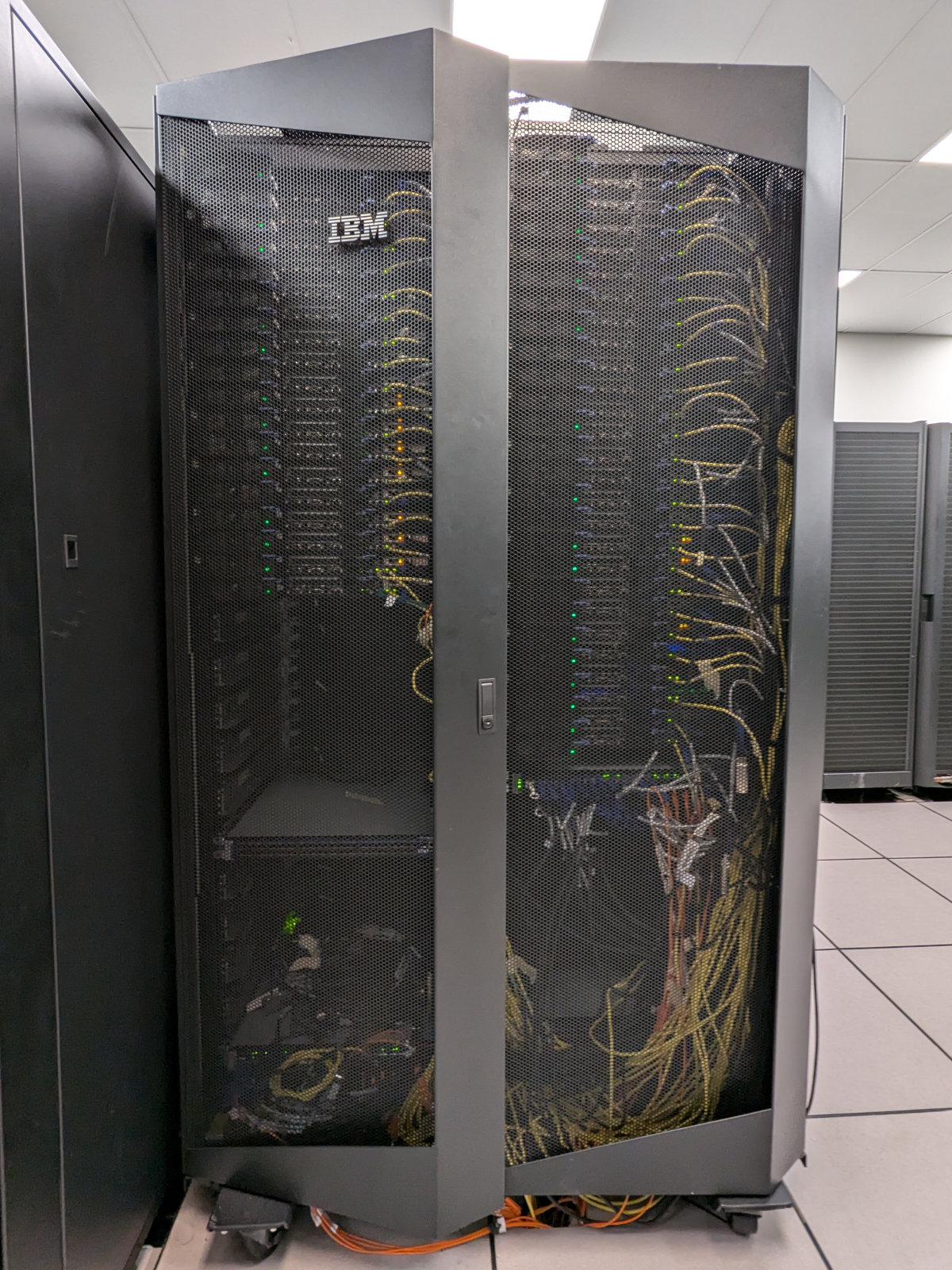
Teach is a cluster of 2560 cores at SciNet consisting of older repurposed compute hardware. Originally assembled in the fall of 2018, it had a complete refresh in February 2025. Access to this modest homogeneous cluster is provided primarily for local teaching purposes. It is configured similarly to the production Trillium system.
The cluster consists of 64 nodes each with 40 cores (two 20-core Intel 2.5 GHz CascadeLake CPUs), with 188GB of RAM per node. The nodes are interconnected with 1:1 blocking EDR Infiniband for MPI communications and disk I/O through the VAST storage systems.
UofT faculty that is interested in using this cluster in their teaching can contact us.